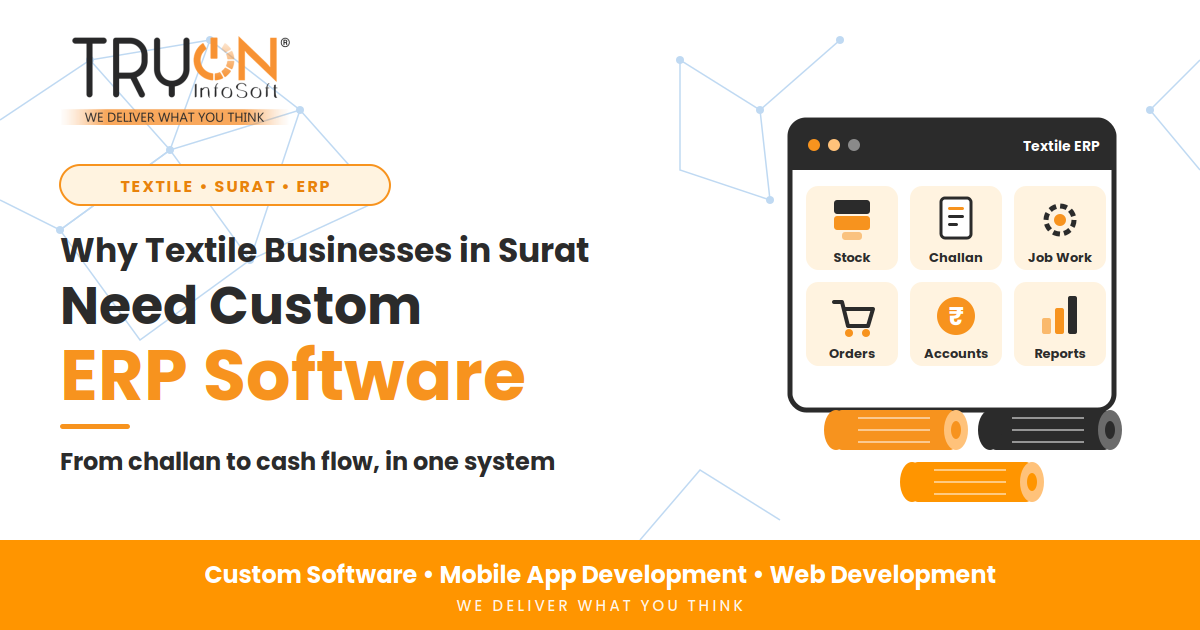
Why Textile Businesses in Surat Need Custom ERP Software
Surat is India’s undisputed textile and man-made fabric powerhouse. Across Ring Road, Millennium Market, Sahara Darwaja, Pandesara, Sachin, and Kadodara, thousands of fabric traders, weavers, yarn suppliers, embroidery units, dyeing processors, digital printers, garment manufacturers, and commission agents work together in a tightly linked ecosystem. A single piece of fabric may pass through four or five separate business units before it reaches the final buyer.
Yet, an overwhelming majority of these businesses still steer multi-crore turnovers using a fragmented mix of Excel spreadsheets, handwritten godown registers, standard Tally entries, WhatsApp audio messages, and individual memory. It works—until it does not.
As a Surat-based IT and software company with 10 years of experience building tailored enterprise solutions, we have observed this friction up close. In this comprehensive guide, we unpack why textile businesses across Surat are transitioning from disconnected tools to custom textile ERP software, what core modules it must include, what it costs in time and investment, and how to execute the shift without halting your daily dispatches.
Why the Textile Business in Surat is Fundamentally Different
Standard, off-the-shelf business software assumes a straightforward, linear flow: Buy → Store → Sell → Invoice. But anyone operating in the Surat textile market knows fabric never works that way.
Here is what makes a Surat textile workflow unique:
Unusual & Multi-Tier Units
You rarely deal in simple units. Fabric is tracked in meters, takas, thans, pieces, sets, kilograms, and bales, with continuous conversions between them at every stage of trade.
Every Lot & Shade is Unique
Quality, shade variance, width (panna), shrinkage, design code, and rate vary lot to lot. A single design number may span dozens of distinct colourways and matching combos.
Multi-Party Job Work Circulation
Grey fabric departs for dyeing, mill printing, hand-work embroidery, stitching, or packaging, returning in transformed states. Every outsourced party requires rigorous tracking.
Shortage, Wastage & Rejection
Shrinkage during dyeing, edge cuts during printing, and defective takas are routine facts of life. Fabric lost or rejected at each stage impacts your true cost per meter.
Agent & Broker-Driven Sales
Commissions, orders, customer disputes, and collection follow-ups flow heavily through intermediate brokers with bespoke percentage and turnover calculation rules.
Credit & Ageing is the Heartbeat
Sales are predominantly on credit (30, 60, or 90 days). Party-wise outstanding ledgers, payment ageing schedules, and timely recovery reminders dictate your working capital.
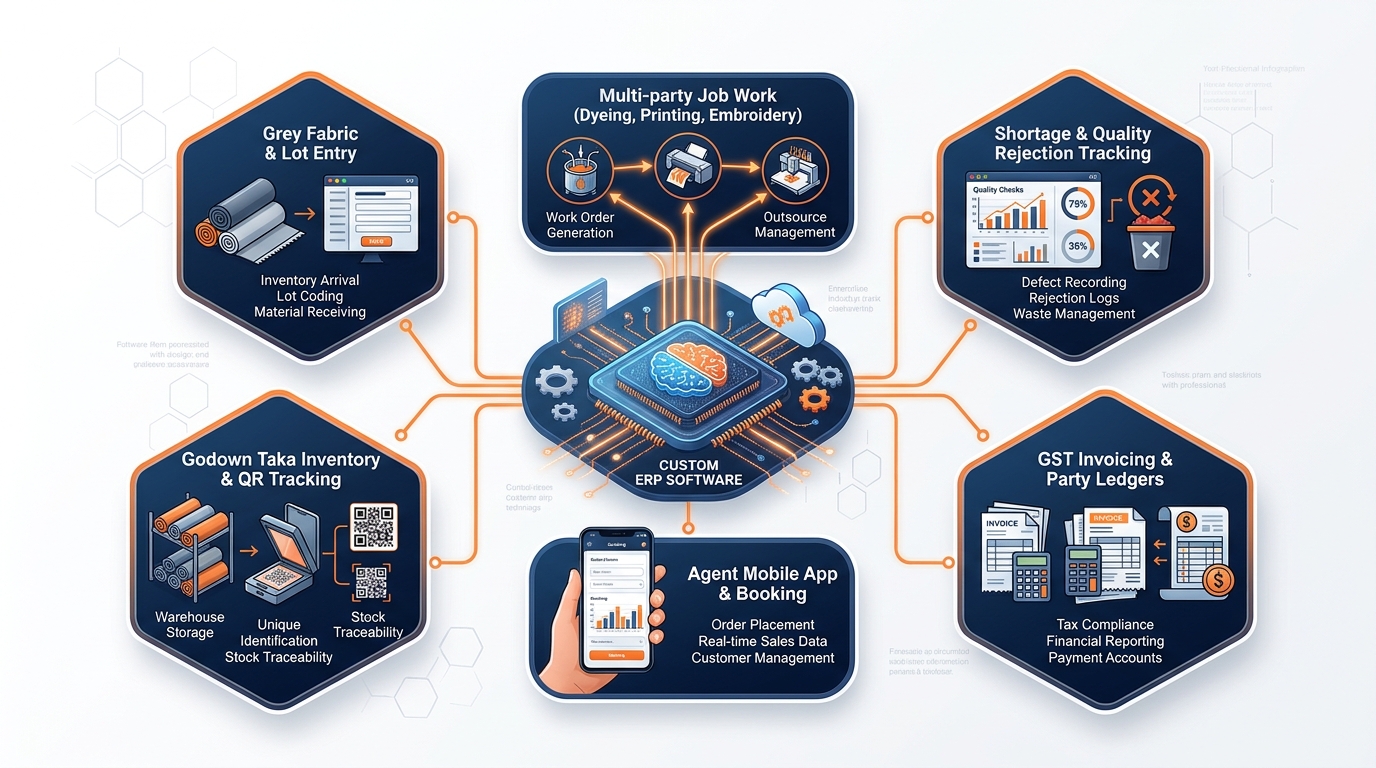
A generic accounting package can handle standard ledger balances. But only a custom textile ERP built specifically around Surat’s market terminology and operational nuances can handle the entire end-to-end fabric chain.
10 Clear Signs Your Textile Business Has Outgrown Excel and Tally
Spreadsheets and standard bookkeeping software are great when you start. But as your takas, godowns, and party accounts multiply, manual workarounds begin leaking profit. If you recognise several of the warning signs below, your current setup is likely costing you far more in errors, delays, and lost sales than custom software would:
Review these common bottlenecks faced by growing Surat textile firms:
What Exactly is a Custom ERP for Textile?
ERP stands for Enterprise Resource Planning. In straightforward terms, it is a single, unified software system that ties together purchases, inventory, production, job work, orders, dispatches, party ledgers, and executive analytics—so your entire team works in sync from the exact same live information.
The fundamental difference between generic enterprise packages and a custom textile ERP lies in adaptation:
A custom textile ERP is built around how your business actually runs: your fabric units, your challan format, your mill processing stages, your agent commission formulas, your godown locations, and your method of billing. You do not twist your business to suit the software. The software adapts directly to your business.
Core Modules a Surat Textile ERP Should Include
Whether you are a pure fabric trader, grey manufacturer, embroidery unit, dyeing mill processor, or ready-made garment house, a robust textile ERP should provide modular flexibility:
Purchase & Inward Management
Purchase order tracking, inward challans, lot number allocation, quality inspection (check-in), supplier-wise rate history, and physical vs billed meter reconciliation.
Multi-Godown Stock & Taka Inventory
Real-time inventory segmented by design number, quality, shade, lot, taka or than, and godown shelf. Barcode / QR label scanning for instantaneous taka audit and pack dispatches.
Job Work Circulation Tracking
Issue and receive fabric to dyeing houses, printing mills, and embroidery units. Automatically monitor pending balance takas with each processor, shortage % thresholds, and job charges.
Stage-Wise Production Tracking
For manufacturers and weavers: stage-wise movement across weaving, scouring, dyeing, printing, finishing, and cutting, recording output, rejection meters, and per-stage production cost.
Sales Orders & Dispatch Challans
Order booking, party-specific quotations, sales challans with exact taka pieces, packing slips, invoice generation, sales returns, and contract rate enforcement.
Agent & Broker Management
Track which agent booked which order, calculate commission automatically based on your specific percentage or collection terms, and generate agent-wise performance summaries.
Party Accounts & Ageing Ledgers
Customer and supplier ledgers, credit limits, 30/60/90-day overdue ageing analyses, automated WhatsApp payment reminders, and bidirectional export/sync with Tally.
GST Compliance & E-Way Bills
GST-compliant tax invoices, e-invoicing JSON generation, automatic e-way bill generation for dispatches, and job-work delivery challan compliance (Form ITC-04 support).
Executive Analytics & Dashboards
Daily dispatch values, cash vs credit ratios, dead-stock warnings for slow-moving shades, margin analysis per design or lot, and godown capacity metrics in a single glance.
Agent Mobile Apps & Buyer Portals
A tailored mobile app for your agents and sales staff to view real-time catalogue stock, share watermarked designs on WhatsApp, and place orders directly into your ERP.
Custom Textile ERP vs Ready-Made Software: The Side-by-Side Reality
Ready-made accounting or generic retail ERP packages can appear attractive because of low initial sticker prices. However, once complex multi-party job work, lot conversions, and agent structures enter the frame, businesses quickly discover that cumbersome workarounds cost substantially more than the software saved:
| Operational Factor | Ready-Made Software | Custom Textile ERP |
|---|---|---|
| Fabric Units (Meters, Takas, Thans, Bales) | Often limited or awkward; forces you to treat takas as generic item quantities. | Built exactly how you trade with dual-unit tracking (pieces & meters). |
| Job-Work Circulation | Basic or missing entirely; requires manual Excel registers for dyeing/printing mills. | Full party-wise issue, receive, balance, shortage %, and processing charge management. |
| Challan & Bill Formats | Rigid, unalterable templates with fields you don’t need and missing ones you do. | Your exact challan design, font size, transport details, and market terms. |
| Agent Commission Rules | Rarely fits; cannot handle sliding percentage scales, payment-linked payouts, or splits. | Configured strictly to your specific broker commission agreements. |
| Design & Lot-Wise Profitability | Extremely difficult to see; shows only aggregated business income. | Standard reporting on profit margin per design code, shade, or mill lot. |
| Integrations (Tally, WhatsApp, E-Way Bill) | Limited or locked behind high monthly add-on fees. | Built to connect seamlessly with Tally, GST portals, barcode printers, and WhatsApp. |
| Starting Cost | Lower upfront cost, but recurring per-user monthly subscription fees. | Higher upfront engineering investment, but with no perpetual user penalties. |
| Fit As Your Business Grows | Workarounds pile up until you outgrow the platform and face painful migration. | Scales effortlessly; new godowns, processing stages, and apps plug right in. |
| Software & Data Ownership | Data sits on third-party cloud servers; subject to vendor lock-in. | You own your solution and source code as agreed in contract. |
Tangible Benefits You Can Realistically Expect
Investing in an ERP is a strategic operational decision. When properly configured and adopted by your staff, here are the real-world advantages you will experience:
Fewer Errors & Zero Duplicate Entry
Enter data once at inward. Challans, packaging lists, invoices, and ledgers pull from one verified source.
Pinpoint Stock Visibility
Know in 5 seconds exactly how many meters of which shade exist across Godown 1, Godown 2, or shop shelves.
Absolute Control Over Job Work
Eliminate untracked fabric loss. Instantly identify delays, unreturned takas, and unauthorized shrinkage.
Faster Cash Flow & Recovery
Ageing alerts and automated payment reminder messages help recover money faster and prevent bad debts.
Accurate Costing & Smart Pricing
Calculate your true cost per meter after processing charges and wastage so you quote with total confidence.
Zero Month-End GST Stress
All sales, credit notes, job-work delivery challans, and e-way data are compiled automatically throughout the month.
Zero Dependency on Memory
Critical business knowledge resides securely in your system database—not locked inside individual employees’ heads.
Faster Selling Through Mobile
Agents check stock directly on their phones and book sales on the spot, closing deals before competitors react.
Room for Limitless Growth
Open a new branch, add five godowns, or launch a garment vertical without rebuilding your administrative backend.
A Day in the Life: Before and After Custom ERP
To see the practical transformation, consider this typical scenario from a Surat saree and fabric wholesale business:
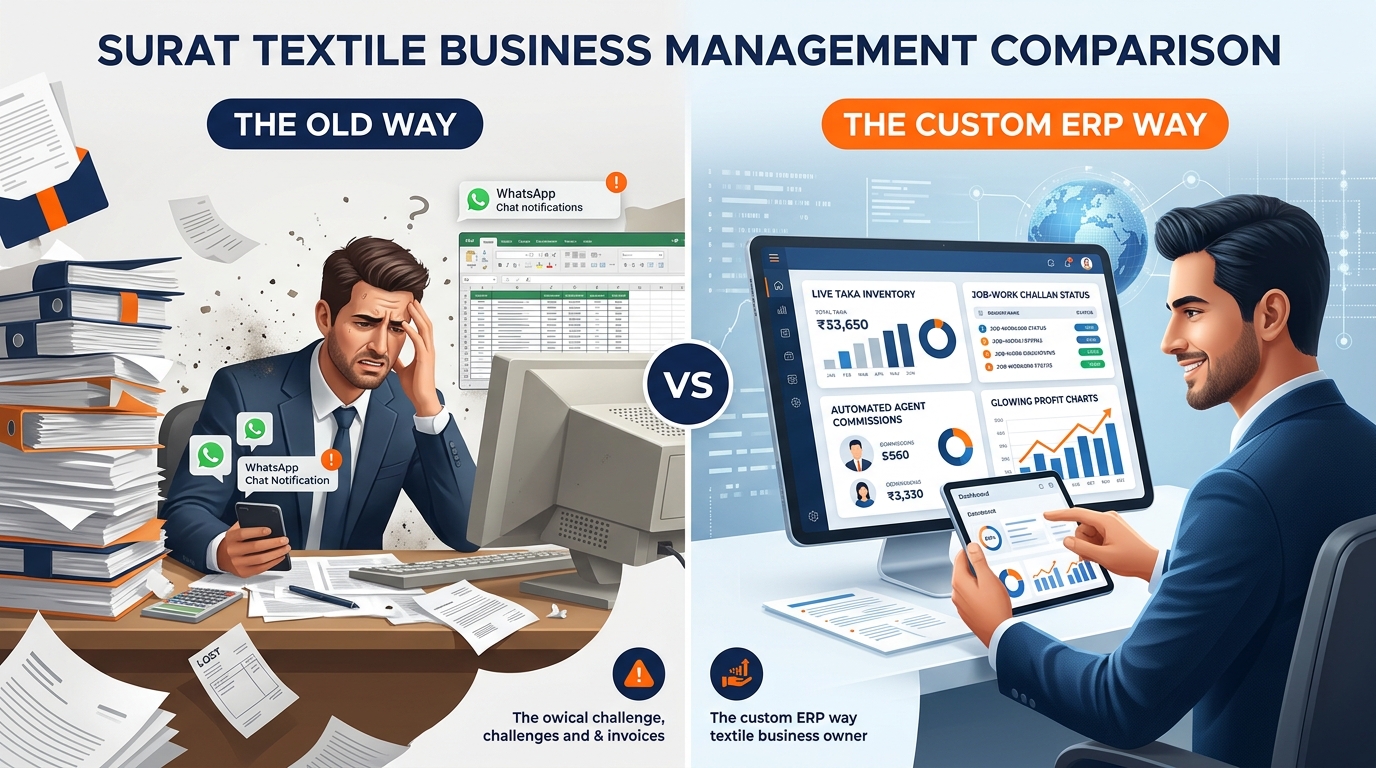
Registers, Calls & Spreadsheets
An agent sends a booking for 200 sarees on WhatsApp. Staff checks a paper book, finds it unclear, and calls the godown supervisor. The godown supervisor physically rummages through shelves to confirm available shades. A challan is written by hand. At night, an assistant copies the slip into Excel. Two days later, an accountant re-types it into Tally. At month-end, the buyer claims 15 pieces were short, nobody has signed proof, and nobody knows if the remaining embroidery lot is ready.
Instant, Transparent Automation
The agent opens the mobile app, views live shade availability, and locks in the order. The ERP instantly earmarks the inventory, prints barcode dispatch slips in the godown, generates a GST invoice, and updates the customer's ledger. As the goods leave, an automated WhatsApp dispatch summary with tracking is sent to the party. The business owner opens their dashboard and reviews today’s turnover, pending dispatches, and fabric at processors—without dialling a single phone call.
What to Look for When Choosing a Textile ERP Partner
Software failure in the textile industry rarely stems from bad technology; it almost always stems from a development team that does not understand how Surat textile operates. When evaluating a technology partner, look for these markers:
- Deep Understanding of Textile Jargon: Does your software vendor understand what a taka, a than, a lot, a grey challan, or a job-work shortage means? If you have to teach them the basic fundamentals of fabric trade, run.
- Willingness to Start with Discovery: Honest partners study your actual paperwork, godown layouts, and invoice formats before spitting out a quote.
- A Structured, Phased Implementation Plan: They should recommend beginning with your highest-friction bottleneck (e.g., stock & job work) before rolling out advanced forecasting.
- Data Migration Support: Dedicated assistance in scrubbing and importing your historical customer ledgers, opening stock, and item masters from Tally and Excel.
- Hands-On Staff Training: Munims, godown boys, and sales personnel need patience, user-friendly Hindi/Gujarati guidance, and hands-on onboarding.
- Local Surat Presence: When peak Diwali or wedding seasons hit, a software hiccup cannot wait for an overseas ticket. Having local support in Surat guarantees fast, responsive resolution.
- Clear Ownership & IP in Writing: Ensure you retain full ownership of your data, database, and source code.
How an ERP Project Works: A Simple 6-Phase Roadmap
Transitioning to custom enterprise software does not have to disrupt your daily business operations. A structured, tested deployment roadmap ensures zero downtime:
Discovery & Workflow Audit (Weeks 1 – 2)
Our engineers sit down with your owners, accountants, godown managers, and sales leaders. We study your physical challans, billing formats, registers, and identify where money and time are lost.
System Architecture & Prototype Design (Weeks 3 – 4)
We finalize screen wireframes, database schemas, user permissions, and report layouts. You see and approve exactly how screens look and feel before coding begins.
Staged Iterative Development
We build modules in logical milestones. You receive functional demo versions early to test and refine, rather than waiting months for a blind surprise.
Data Migration & Rigorous Testing
Your party accounts, opening balances, item catalogs, and existing takas are cleaned and migrated. We run end-to-end stress tests with your actual historical scenarios.
Staff Training & Parallel Run
Your staff receives thorough, hands-on training. You run your legacy registers/Excel alongside the new ERP for a short trial window until confidence reaches 100%.
Go-Live & Ongoing Local Support
We switch over fully to the ERP. Our engineering team remains on standby during initial weeks to resolve questions quickly and continuously fine-tune performance.
How Much Does a Custom Textile ERP Cost?
There is no honest single flat price, and any vendor who quotes a blanket figure without examining your workflow is simply guessing. The primary investment variables include:
- Module Breadth: Core inventory & challans vs. full multi-mill job work, spinning/weaving production, and mobile apps.
- Operational Complexity: Straight single-stage trading versus multi-stage dyeing, printing, and embroidery manufacturing.
- Scale & Users: Single-shop setup vs. 5 connected godowns, remote branches, and 50+ roving agents.
- Hardware & Third-Party Integrations: WhatsApp Business API, automatic e-way bill portals, barcode scanners, and weighing scale links.
The Smarter Financial Question: Rather than asking "What does the ERP cost?", shrewd Surat business owners ask: "What is my current way of working costing me every month?" When you calculate staff hours wasted re-entering numbers, uncollected receivables, disputed bills, untracked processor shortages, and dead stock, most owners find that a custom ERP pays for itself within the first 6 to 12 months.
7 Common Pitfalls to Avoid During Implementation
To protect your technology investment and ensure high user adoption, avoid these standard implementation mistakes:
- Trying to Build Everything on Day One: Do not attempt to automate every edge-case in phase one. Solve your biggest daily pain points first, stabilize, and expand.
- Leaving Godown & Accounts Staff Out of Planning: If your ground-level team isn't consulted during screen design, they will resist using the system.
- Migrating Garbage Data: Duplicate party names, outdated phone numbers, and dead item codes will pollute your new software. Clean your registers before migration.
- Selecting Exclusively on Lowest Bid: The cheapest software developer invariably becomes the most expensive mistake once rework, missed deliveries, and broken databases hit your operations.
- Failing to Appoint an Internal Project Champion: Someone inside your firm must own the system rollout and hold employees accountable for timely data entry.
- Underestimating Training: Software is only as effective as the humans operating it. Treat staff onboarding with the priority it deserves.
- Neglecting Data Security & Access Controls: Your client ledgers, design catalogues, and pricing formulas are high-value intellectual assets. Insist on role-based permissions and daily encrypted backups.
Who Needs a Custom Textile ERP Most?
In our decade of software engineering experience across Gujarat, custom ERP delivers the highest return on investment for:
Grey & Finished Fabric Traders
Firms managing rapid daily taka movements, hundreds of party accounts, and multi-godown storage.
Saree, Dress Material & Kurti Houses
Manufacturers handling thousands of evolving design codes, catalog colorways, and seasonal launches.
Embroidery & Mill Processors
Units that process job work for dozens of third-party clients and require ironclad delivery balance records.
Firms with Active Agent Networks
Wholesalers who need to provide brokers with instant live catalog stock without endless telephone calls.
How Tryon Infosoft Can Help Your Textile Business
Tryon Infosoft is a premier Surat-based software development company. Since 2016, we have engineered custom ERP platforms, mobile applications, and web management systems for thriving enterprises across Surat, Ahmedabad, Mumbai, and all of India.
We do not sell cookie-cutter templates. We examine your distinct operation and engineer software specifically tailored to your team:
- Complete End-to-End Textile ERP: Inward, lot management, job-work challans, taka barcodes, accounts, and GST compliance.
- Dedicated Mobile Apps for Agents & Owners: Android & iOS apps for real-time stock checks, order booking, and executive oversight.
- Custom Buyer & Broker Portals: Secure web portals where VIP buyers view dynamic catalogs and download invoices.
- Seamless Tally & Hardware Integrations: Direct synchronization with your accounting software, thermal barcode printers, and WhatsApp gateways.
- Hands-On Staff Training & Local Surat Support: Local team on the ground to assist whenever you need guidance.
Want to See What a Custom ERP Could Do for Your Textile Business?
Tell us how your business currently operates, and we will show you exactly where custom software can save hours and eliminate errors—with total transparency, zero jargon, and zero sales pressure.
Frequently Asked Questions (FAQ)
Tally is excellent for core accounting. But it was never designed for lot-wise stock, taka-to-meter conversions, multi-stage job-work tracking, or agent mobile ordering. Most forward-thinking Surat businesses keep Tally for accounting compliance and deploy a custom ERP for daily operations, syncing data automatically between the two.
Not at all. Small and mid-sized fabric traders and embroidery units experience significant ROI whenever their operations involve multi-party job work, diverse lots, or heavy credit. Starting with a modular ERP focusing on core stock and job work keeps upfront costs manageable.
A focused phase-one rollout (e.g., inventory, inward challans, and job-work tracking) can go live within 6 to 10 weeks. Comprehensive multi-factory systems take longer, but phased delivery ensures you begin reaping operational benefits right away.
Yes. That is precisely why custom development is essential. A custom textile ERP uses dual-unit tracking formulas based on your specific quality standards and automatically reconciles meter shrinkage when takas return from processors.
Yes. We build native or cross-platform mobile apps for Android and iOS that enable agents to check real-time stock availability, view digital design shade cards, book orders, and review customer payment dues on the road.
Yes. Our ERP generates GST-compliant invoices, automatically formats e-way bill dispatches, and tracks job-work delivery challans (ITC-04). We ensure everything aligns with the statutory guidance of your Chartered Accountant.
We work directly alongside your team to clean, format, and migrate your customer lists, vendor accounts, opening stock, and pricing tiers into the new database so you start cleanly without losing business history.
Yes. With custom software developed by Tryon Infosoft, your database and proprietary code belong to you as specified in your agreement. You are never held hostage by arbitrary licensing lock-ins.
We design interfaces for speed and simplicity, using keyboard shortcuts, large buttons, barcode scanners, and Gujarati/Hindi terminology where beneficial. In our experience, staff members adapt within a week because the screens match the physical challans they already know.