Custom Software vs Ready-Made Software: Which Is Right for Your Business?
At that point, you face a big question: should you buy ready-made software, or build custom software for your business?
There is no single right answer. We have worked with businesses across India since 2016, and we have seen both choices succeed and both fail. The difference is almost never the software itself. It is whether the choice matched the business.
This guide explains both options in plain language, compares them honestly, and gives you a simple way to decide.
What is ready-made software?
Ready-made software, also called off-the-shelf or packaged software, is a product built for many businesses at once. You buy a licence or pay a monthly subscription and start using it, often within days.
Common examples include accounting tools, billing software (such as our own Billing Buddy product), CRM platforms, HR and payroll tools, and e-commerce platforms.
Because the same product is sold to thousands of customers, the cost of building it is shared. That is why it is usually cheaper to start with.
What is custom software?
Custom software, also called bespoke software, is built from scratch (or on a strong framework) for one specific business. It is designed around your workflows, your users, your reports and your goals.
Instead of changing how you work to fit the software, the software is shaped to fit how you work. Examples include a custom ERP solution for a manufacturer, a tailor-made inventory and billing system for a trader, a booking platform for a service business, or a custom mobile app for your customers.
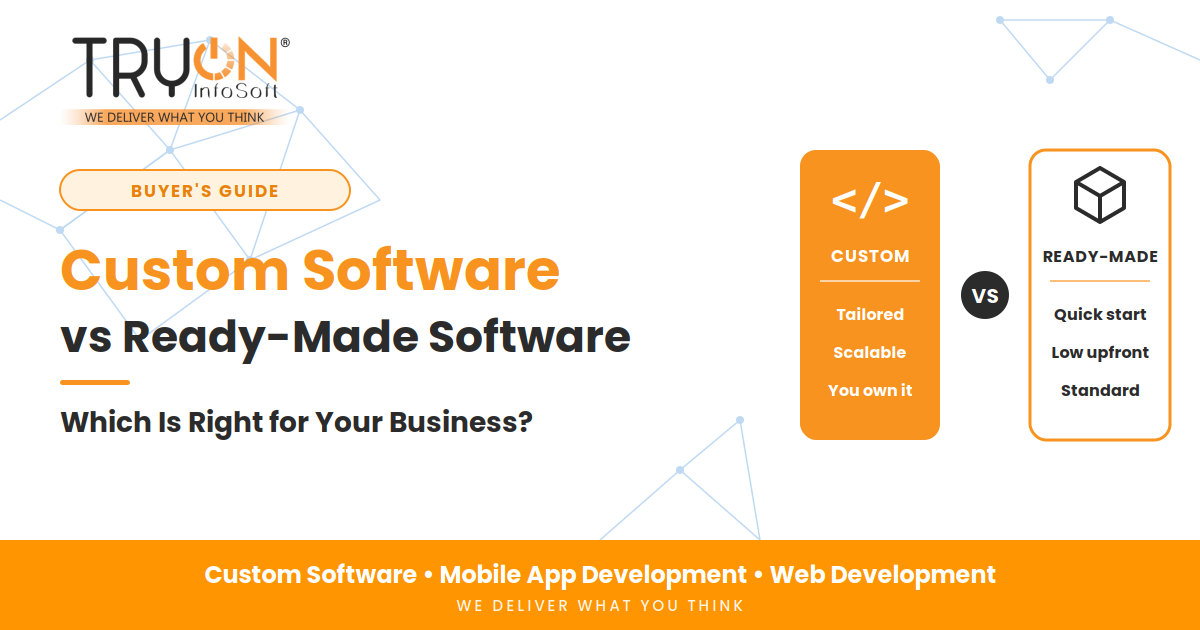
Custom vs ready-made software: side-by-side comparison
Here is an honest side-by-side look at how both approaches compare across the key factors that matter to business owners:
| Factor | Ready-Made Software | Custom Software |
|---|---|---|
| Upfront cost | Low | Higher |
| Long-term cost | Recurring fees that grow with users and features | Higher initial investment, often lower over time |
| Time to start | Days or weeks | Weeks to months |
| Fit with your process | Generic, you adapt to it | Built around your process |
| Features | Many you may never use; some you need may be missing | Only what you need |
| Flexibility | Limited to what the vendor allows | Change it whenever the business changes |
| Scalability | Depends on the plan and vendor | Designed for your growth |
| Integrations | Limited to supported tools | Can connect to anything with an API |
| Ownership | You rent the right to use it | You own the software and code (as agreed in contract) |
| Support | Shared with all customers | Dedicated to you |
| Competitive edge | None, competitors use it too | Can be a real advantage |
The real advantages of ready-made software
Ready-made software is not the "lesser" option. For many businesses it is the smarter choice. Here is why:
-
1Low starting cost
You do not need a large budget upfront. A monthly subscription is easy to approve and cash-flow friendly.
-
2Fast to start
You can sign up and begin work the same week. This matters significantly when you need an immediate solution.
-
3Proven and tested
Thousands of users have already found the edge-case bugs. Mature off-the-shelf products are usually battle-tested and stable.
-
4Regular updates
The vendor handles underlying upgrades, security patches, compliance updates and new feature rollouts automatically.
-
5Easy to try
Many tools offer free trials or sandbox environments, so your team can test usability before committing financially.
The limitations of ready-made software
The same qualities that make ready-made software attractive can become bottlenecks as your organization expands:
-
1It is built for the average business
If your operating process is unique, you will find yourself using clunky workarounds, spreadsheets on the side or manual double-entry that the software cannot handle.
-
2Costs add up quickly
Per-user pricing, add-on modules, premium storage tiers and higher plans can make a "cheap" tool surprisingly expensive after a few years.
-
3You depend entirely on the vendor
If the vendor changes pricing tiers, removes a feature your workflow depends on, or shuts down, you have little control.
-
4Limited integration capabilities
Connecting the tool with your existing accounting system, proprietary databases or local hardware may be restricted or impossible.
-
5Your data is on someone else's terms
Exporting, backing up or migrating your business data later can be far harder and more restrictive than expected.
The real advantages of custom software
When built with the right architecture, custom software transforms from a simple utility into a core strategic asset:
-
1It fits like a glove
Every screen, report and workflow is built around how your team actually works. Staff spend less time fighting the tool and more time doing productive work.
-
2It grows with you
New branches, product categories, user roles or operational processes can be added seamlessly without having to start over or switch platforms.
-
3It automates what is unique to you
Complex approval chains, custom pricing rules, multi-stage production steps and industry-specific calculations can be automated, not just recorded.
-
4Seamless integration
Custom software can talk directly to your accounting software (like Tally), payment gateways, WhatsApp Business API, SMS routes, courier partners or barcode scanners.
-
5You control security & privacy
You decide where data is hosted, who can see specific records, how permissions are managed, and how backups are conducted.
-
6You own the asset
Software built for you becomes a valuable company asset rather than a permanent recurring expense, subject to terms agreed with your development partner.
-
7A decisive competitive edge
When your internal systems do something your competitors' standard systems cannot (such as instantaneous quoting or live job tracking), that becomes part of your market advantage.
The limitations of custom software
To be fair and transparent, custom software involves real trade-offs that every business owner must weigh:
-
1Higher upfront investment
Building tailored software from scratch requires higher capital investment at the start compared to subscribing to a tool.
-
2It takes longer to launch
Thorough planning, UI/UX design, engineering and rigorous testing take weeks or months, rather than immediate same-day signup.
-
3It demands a reliable development partner
The quality of your result depends heavily on the team you choose. An inexperienced choice can mean timeline delays, code bugs and wasted money.
-
4You need to maintain it
Server hosting, performance monitoring, OS updates, bug fixes and routine improvements need an ongoing support plan.
-
5Requirements must be clear
If you are unsure of what problem you are solving, the project can experience scope creep. Proper discovery work upfront solves this completely.
Cost: the question everyone asks
Most people compare only the starting price, and that can be misleading. A far better, more accurate view is the total cost of ownership (TCO) over three to five years.
For Ready-Made Software, Add Up:
- Subscription or licence fees for all current and future users
- Add-on modules and forced higher tiers as you grow
- Third-party plugin, connector or Zapier subscription costs
- Staff training and repetitive data migration costs
- The hidden cost of workarounds, errors, and manual Excel work
For Custom Software, Add Up:
- One-time architecture & development cost
- Hosting and cloud infrastructure
- Periodic maintenance, security updates and technical support
- Future iterative feature improvements as business expands
A simple example (illustrative only): A business paying a monthly fee per user for a tool with 30 users, plus add-ons, may pay for the equivalent of a custom build within a few years, and still not own anything. On the other hand, a small business with five users and standard needs may never recover the cost of a custom build.
The lesson: run the numbers for your situation, and include the cost of inefficiency, not just the invoice.
- 1. Your business process is fairly standard for your industry.
- 2. You need an operational solution immediately (within days or weeks).
- 3. Your upfront capital budget is limited right now.
- 4. A proven product already exists that comfortably covers 80 to 90 percent of your daily needs.
- 5. You have a small team with very few system users.
- 6. You are still testing your business model or service offering.
- 7. The software function is not central to your competitive advantage (for example: basic accounting or company email).
- 8. You do not have the internal time or bandwidth to manage a development project.
- 1. Your team is forced to use multiple disconnected tools plus Excel spreadsheets just to complete one job.
- 2. You keep paying recurring fees for complex features you never use, while missing the exact ones you actually need.
- 3. Your operational process is unique and off-the-shelf tools cannot handle it without frustrating workarounds.
- 4. You have outgrown your current packaged software and feel stuck or limited by vendor constraints.
- 5. You need tight, seamless integration between internal systems, ERPs, logistics, and customer portals.
- 6. Data security, privacy, client confidentiality or regulatory compliance is a major priority.
- 7. You plan to scale rapidly to more users, branches, manufacturing units, or multi-city locations.
- 8. The software is central to your product delivery, customer experience, or competitive pricing model.
If you recognize four or more signs in the custom software list, it is worth seriously exploring a bespoke solution.
Industries where custom software often makes the biggest difference
In our decade of software engineering experience across India, custom software tends to deliver the highest return on investment where business processes are specialized and multi-layered:
Lot tracking, challan creation, job-work contractor management, fabric inspection, and multi-stage dyeing/weaving/printing production cycles.
Production planning schedules, raw material batch tracking, bill of materials (BOM), machine maintenance logs, and quality control checkpoints.
Real-time inventory management across multiple godowns, party-wise tiered pricing, credit limit controls, and outstanding payment tracking.
Fleet dispatching, consignment tracking, trip expense management, driver mobile apps, and customer proof-of-delivery alerts.
Online booking engines, appointment scheduling, field technician dispatching, customer self-service portals, and digital invoicing.
A unique, proprietary digital product where the web or mobile platform itself is the core commercial business model.
The middle path: a hybrid approach
The choice is not always strictly either/or. In fact, many of the smartest, most cost-effective businesses implement a hybrid model:
- Use ready-made tools for standard commodity functions like email (Google Workspace), basic accounting (Tally / Zoho), and standard HR.
- Build custom software for the core, differentiating operational workflows that give your business its competitive edge.
- Connect them via APIs so data flows seamlessly between systems without repetitive human data entry.
Another pragmatic option is to start with a ready-made tool and customize it via plugins, or build a lean Minimum Viable Product (MVP) first and expand iteratively as you learn what works. This drastically reduces financial risk and spreads your investment sensibly.
How to decide: a simple 5-question test
Before you sign a contract or hire a software development team, ask yourself these five questions:
If yes, start there and evaluate it with a pilot team.
If yes, lean strongly towards custom development.
More users and fast expansion strongly favour custom software over per-user monthly SaaS fees.
Compare total cost of ownership over 3-5 years, not just the starting upfront quote.
If yes, custom software is low-risk. If not, begin with a discovery phase or a ready-made tool to clarify your requirements first.
Common mistakes to avoid
-
Choosing solely on upfront price
The cheapest option today frequently becomes the most expensive over time due to inefficiencies, recurring add-ons, or total re-platforming.
-
Skipping the requirements and discovery stage
Unclear operational requirements always lead to the wrong software, whether you buy packaged software or build bespoke.
-
Over-customising a rigid ready-made tool
If you find yourself rewriting 60% of an off-the-shelf product with fragile plugins, you are almost always better off with custom software.
-
Trying to build everything on day one
Avoid massive "big-bang" releases. Start with the most vital core operational features first, put them into production, and evolve.
-
Ignoring ongoing maintenance and support
Software is a living business asset, not a stationary furniture purchase. Always budget for routine maintenance, security patches, and server hosting.
-
Failing to confirm source code ownership terms
When contracting custom development, ensure your agreement explicitly guarantees full intellectual property and source code handover upon completion.
How to choose the right development partner (if you go custom)
If your evaluation points to custom software, choosing the right engineering team is the single most critical factor for success:
- Look for relevant experience in your industry vertical or in managing similarly complex business workflows.
- Ask to review past work, case studies, and live demonstrations rather than just accepting sales slides.
- Ensure they begin with discovery and detailed planning, rather than blindly throwing out a quote within an hour.
- Expect clear, regular milestone communication with working sprint demos every two weeks.
- Check for thorough quality assurance (QA), data security protocols, and device compatibility testing.
- Confirm clear post-launch support and SLA terms to guarantee long-term stability and fast response times.
- Get source code ownership, non-disclosure confidentiality, and delivery timelines in writing.
How Tryon Infosoft can help
Since 2016, Tryon Infosoft has helped hundreds of businesses across India decide between ready-made tools and custom applications—and build the right software when custom was the answer. We will never push you towards an expensive custom build if a standard ready-made tool fits your business better. Our job is to give you honest, objective engineering advice first.
Our core engineering capabilities include:
- Custom Software Development: tailored ERP systems, CRM portals, order tracking, and multi-godown inventory software.
- Mobile App Development: high-performance native and cross-platform apps for Android and iOS.
- Web Development: scalable modern corporate websites, e-commerce solutions, and customer portals.
- Python & Odoo ERP Solutions: modular enterprise management built for growing trade and industry.
Final thoughts
Ready-made software is best when you need speed, low upfront cost and standard features. Custom software is best when your process is unique, your business is growing and software is central to how you compete.
The smartest approach is to evaluate your real needs, compare total cost over time, and choose the option—or the combination—that supports where your business is going, not just where it is today.
Frequently asked questions
Is custom software always more expensive than ready-made software?
It costs more upfront. Over several years, the gap often narrows or reverses, especially for growing businesses that would otherwise pay per-user fees, add-ons and workaround costs.
How long does it take to build custom software?
It depends on complexity. A focused first version can take a few weeks to a few months, while larger systems like a full ERP take longer. Building in phases helps you start using it sooner.
Can I start with ready-made software and switch to custom later?
Yes. Many businesses do exactly this. Just make sure you can export your data, so migration is smooth when the time comes.
Do I own custom software built for me?
Typically yes, but it depends on your agreement. Always confirm source code ownership and handover terms in writing before the project begins.
Is custom software more secure?
It can be, because you control how it is built and who can access it. But security depends on how well it is developed and maintained, so choose an experienced team.
What if I only need a few special features?
Then a ready-made product with a custom add-on or integration may be the most cost-effective route. A good development partner can help you assess this.
Not sure which option is right for your business?
Talk to our team. Tell us how your business works and what is slowing you down, and we will give you an honest recommendation, whether that is a ready-made tool, a custom solution or a mix of both.
Book a free consultation with Tryon Infosoft today.