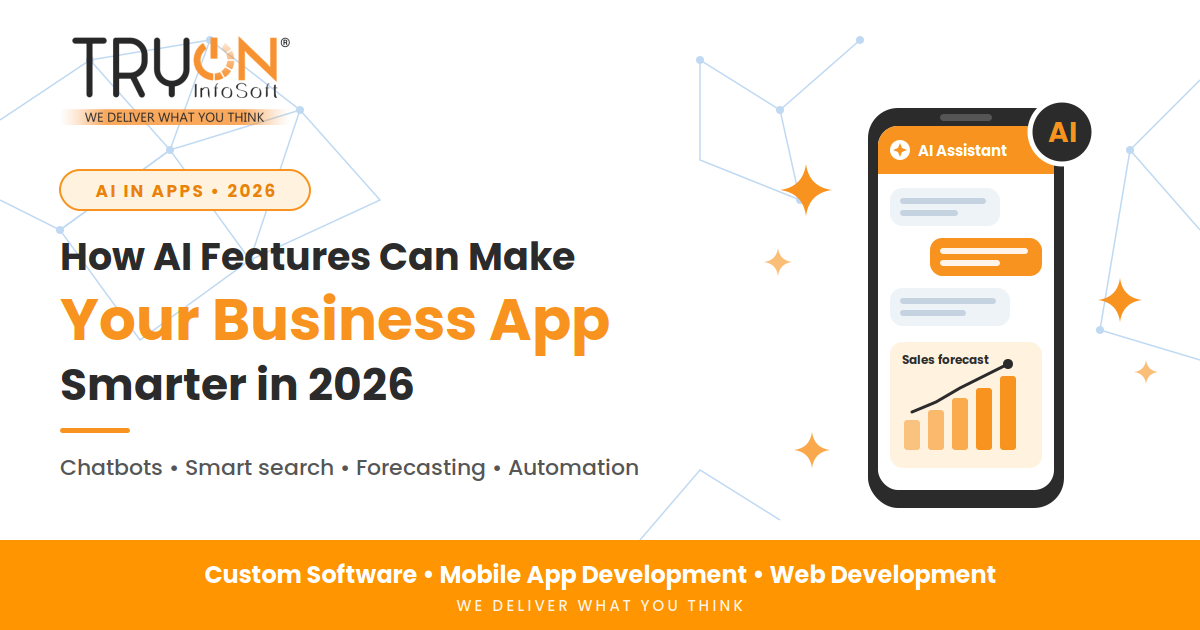
How AI Features Can Make Your Business App Smarter in 2026
But there is also a lot of noise. Many businesses hear "AI" everywhere and are not sure what it actually means for their app: what is useful, what is hype, and where to begin.
At Tryon Infosoft, we build custom software, mobile apps and web platforms for businesses across India. This guide explains, in plain language, which AI features can genuinely make a business app smarter, where they work best, what to watch out for, and how to start without wasting money.
What do we mean by "AI features" in a business app?
An AI feature is a capability inside your app that can understand, predict, generate or decide something, instead of just following fixed rules.
A normal app does exactly what it is told: if this, then that. An app with modern AI features can also:
- Understand natural language, images, voice and documents effortlessly
- Predict what is likely to happen next, such as seasonal product demand, supply delays or customer churn
- Generate contextual text, executive summaries, customer replies and automated reports
- Recommend the next best action, reorder volume or relevant product
- Automate administrative work that previously required a human to manually read, sort or decide
The goal is not to make your app "futuristic". The goal is to save time, reduce errors, help staff decide faster and give customers a better experience.
10 AI features that can make your business app smarter
AI Chatbots and Virtual Assistants
The most common starting point. A modern AI assistant can answer customer questions, track orders, book appointments, collect leads and hand over to a human team member when needed, 24/7.
Unlike older rigid rule-based chatbots, today's assistants understand natural conversational language, including mixed Hindi-English (Hinglish) or Gujarati-English messages, and can be trained directly on your own product catalogue, return policies and company FAQs.
Smart Semantic Search
Traditional search requires exact keywords. AI-powered vector search understands underlying meaning and intent. A customer or staff member can type "red cotton kurti under 800" or "invoices pending from last month" and get the accurate result immediately, even if those exact words are not written in your database.
This is exceptionally valuable in apps with large inventories, extensive document repositories or intricate operational records.
Personalised Recommendations
AI can learn from what each user views, purchases or searches, then suggest tailored products, content or next actions. Done well, this measurably boosts repeat orders and average transaction value.
It works for customer-facing applications ("customers like you also ordered...") as well as internal staff portals (suggesting the next urgent task or the most probable stock replenishment for a wholesale distributor).
Demand Forecasting and Predictive Analytics
Instead of only reporting historical transactions from last month, AI models forecast what is likely to occur next: expected sales velocity, raw material stock requirements, cash collection delays or upcoming seasonal peaks.
For businesses with festival-driven demand cycles—such as textiles in Surat, apparel retail or FMCG across India—accurate demand forecasting means less tied-up dead stock and far fewer missed sales opportunities.
Document & Data Extraction (OCR + AI)
Many businesses still expend countless staff hours typing data from physical invoices, tax bills, challans, purchase orders and paper forms. Modern AI vision and OCR models read these documents—whether scanned, photographed via mobile phone or PDF—and extract line items and tax figures directly into your ERP or database.
This drastically cuts manual labor, eliminates human typographical errors, and accelerates vendor billing and accounting reconciliations.
Automated Summaries and Report Generation
AI can distill millions of data points into crisp, human-readable executive briefings. For example:
- • A morning WhatsApp summary of daily sales, pending shipments and overdue receivables
- • An instant analytical explanation of why weekly conversions dipped in a specific branch
- • A customer call or client meeting transcript summarized with direct action items
Business owners and branch managers get actionable clarity in seconds without having to manually sift through complex spreadsheet dashboards.
Voice Input and Multilingual Voice Assistants
In India, where businesses employ team members speaking multiple regional dialects, voice is a tremendous operational differentiator. Users can simply speak into the app to log inventory, record orders or ask questions in Hindi, Gujarati or English.
This unlocks enormous efficiency for on-field technicians, delivery drivers, warehouse staff and shopkeepers who find keyboard typing on smartphones slow or inconvenient.
Image Recognition and Computer Vision
Computer vision models can inspect images and camera feeds in real time. Practical use cases include automated fabric defect detection on factory lines, identifying spare parts from a quick camera snapshot, verifying government ID cards (Aadhaar/PAN) for KYC, and assessing vehicle or cargo damage.
In manufacturing and retail, visual AI catches quality anomalies early before defective shipments reach your customers.
Fraud and Anomaly Detection
Machine learning models excel at recognizing unusual behavioral patterns: an unexpected spike in customer refund requests, an abnormal payment transaction from a foreign IP, an unauthorized login attempt outside business hours, or discrepancies in vendor purchase rates.
These anomalies are automatically flagged for manager review before turning into costly financial leakages or data breaches.
Workflow Automation and Autonomous AI Agents
This represents one of the most transformative technology shifts in 2026. Beyond simply answering user questions, autonomous AI agents can execute multi-step business workflows across your platforms: parsing an incoming WhatsApp order, verifying stock in the ERP, generating a proforma invoice, updating the CRM, and dispatching alerts to the dispatch manager.
With strict guardrails, human approvals and activity logging, AI agents allow lean operations teams to handle exponentially higher order volume without increasing headcount.
Before and after: what changes in a real business app
When implemented thoughtfully, here is the tangible transformation between a conventional database app and a modern AI-enabled business application:
| Operational Area | Traditional App | App with AI Features |
|---|---|---|
| Customer Support | Staff answer repetitive routine questions manually all day | AI handles 80% of common queries instantly 24/7; staff solve high-value complex cases |
| Search & Discovery | Rigid exact keyword matches; zero results for minor spelling errors | Semantic search understands colloquial language, intent and regional phrasing |
| Data Entry & Invoicing | Operators spend hours re-typing figures from paper challans & PDF bills | Intelligent OCR reads document images and populates line items automatically |
| Reports & Analytics | Staff manually compile spreadsheets and build static charts | AI proactively explains emerging trends, anomalies and revenue causes in plain text |
| Inventory & Stock | Purchasing orders based on manual guesswork and memory | Forecasts recommended stock volume based on historical patterns and upcoming festival spikes |
| Sales Follow-Up | Depends entirely on sales executive notes and calendar reminders | AI automatically suggests which dormant client to contact and the ideal product pitch |
| Security & Fraud | Static rule-based validation that fraudsters easily bypass | Machine learning flags unusual transaction behavior and anomalous access dynamically |
Where AI helps different industries
Across different Indian commercial sectors, AI provides tailored advantages tailored to specific operational hurdles:
Seasonal & festival demand forecasting, visual fabric catalogue search, automated challan and vendor invoice data extraction, and automated party-wise payment follow-up reminders.
Hyper-personalized product recommendations, natural language search, AI-powered customer service chat, and dynamic abandoned-cart recovery nudges over WhatsApp.
AI-driven production line planning, computer vision quality inspection on conveyor belts, predictive equipment maintenance alerts, and raw material requirement modeling.
Smart route and arrival time (ETA) estimation, freight document automation, transit delay predictions, and hands-free voice-guided driver mobile apps.
Patient appointment scheduling assistants, patient history record summarization, and automated medicine intake reminders—engineered under strict medical data confidentiality.
Adaptive personalized learning tracks, 24/7 student doubt-solving conversational assistants, and automated student assessment grading aids.
The benefits: what you can realistically expect
When businesses integrate targeted AI features with well-defined KPIs, the return on investment surfaces in six primary areas:
-
1Significant time saved
Repetitive manual tasks like data entry, ticket triage and first-level WhatsApp replies shrink dramatically, freeing hours every day.
-
2Fewer human errors
Automated document extraction and automated data verification reduce costly manual typographical and calculation mistakes.
-
3Faster, sharper business decisions
Automated daily summaries and demand forecasts empower business owners and executives to act with confidence days ahead of competitors.
-
4Elevated customer satisfaction
Instant answers at midnight and tailored product suggestions build trust, resulting in higher customer loyalty and retention.
-
5Effortless operational scalability
Your business can comfortably handle 3x to 5x higher order volumes and client queries without a corresponding increase in back-office headcount.
-
6A decisive competitive edge
When your mobile app or internal system operates with intelligent speed while competitors still rely on manual notebooks, customers notice.
A note on honesty: results vary with your data quality, your operational processes and how thoughtfully the feature is engineered. AI is a powerful business tool, not magic.
What to watch out for (Risks & Realities)
A dependable technology partner will be candid about the risks and pitfalls before writing a line of code:
-
AI can produce inaccurate answers (Hallucinations)
Generative AI can sometimes formulate convincing yet incorrect outputs. For critical tasks like legal agreements, pricing tables or medical data, systems must be grounded in your own verified database using RAG (Retrieval-Augmented Generation) with human approval fallbacks.
-
Data quality is the foundation
An AI model is only as smart as the data backing it. If your database contains duplicate party records, missing inventory numbers or corrupted ledgers, clean your data first.
-
Data privacy and compliance in India
When transmitting business or customer data to cloud AI services, companies in India must strictly adhere to the Digital Personal Data Protection (DPDP) Act, 2023. Sensitive client records must remain encrypted and isolated.
-
Ongoing usage costs
Many commercial AI APIs operate on token- or transaction-based billing. While an initial proof-of-concept is inexpensive, token consumption multiplies with volume. Proper caching and token monitoring are essential.
-
Over-automation and lack of human touch
Not every touchpoint should be automated. Always preserve a clear "human-in-the-loop" mechanism where critical financial decisions or dissatisfied customers can immediately reach a human manager.
-
Starting with the technology instead of a concrete problem
The most common corporate blunder is adding AI simply because it is trendy. AI must always be deployed to solve a measurable business bottleneck.
How to add AI to your business app: a practical 6-step approach
Rather than committing massive capital to an uncertain overhaul, we recommend this disciplined, risk-managed 6-step roadmap:
Where does your team spend the most tedious hours? Where do customer orders drop off? Where do manual typos cost real money?
Start small with a single focused initiative that has clear metrics—such as an automated support bot on your website or an OCR tool for supplier bills.
Verify whether you possess the historical catalogue records, FAQ documents, or transactional ledgers required to ground the model accurately.
Deploy the prototype to a trusted group of staff or beta customers. Measure time saved, error rates, staff feedback, and conversion uplift.
Build fallback rules for edge cases, role-based access controls, comprehensive prompt auditing, and human verification checkpoints.
Use the concrete proof of value from your initial pilot to justify subsequent feature rollouts and deeper system integrations.
Should you add AI to an existing app or build a new one?
In the majority of scenarios, you do not need to rebuild your software from scratch. As long as your existing codebase is reasonably modular, modern AI capabilities can be connected via REST APIs, microservices or webhooks.
A complete rebuild is only warranted if your legacy software is built on obsolete technologies that cannot support API connectivity or secure database access. In that scenario, engineering a modern, AI-first custom software solution is far more cost-effective in the long run.
How much does it cost to add AI to a business app?
Implementation costs depend directly on feature complexity, data readiness, and integration depth:
Simple Features
Support chatbots trained on your company FAQs, natural language search, or automated daily sales summary emails. Most affordable and fastest to launch.
Medium Features
OCR document extraction for bills & challans, predictive demand forecasting, and personalized B2B reordering engines. Requires tailored data engineering.
Enterprise Agents
Custom proprietary models, real-time computer vision inspection, and autonomous multi-step workflow agents. Requires comprehensive architecture design.
Always factor in ongoing operating expenses: third-party AI model token consumption, secure cloud hosting, and ongoing model monitoring. A reliable development partner will provide complete clarity on both upfront engineering and recurring running costs.
AI app trends to watch in 2026
- Autonomous AI Agents: AI moving from conversational advisors to active task executors that complete end-to-end operational routines.
- Multilingual Voice-First Systems: Native voice interactions empowering regional-language users across India without keyboard barriers.
- Embedded AI in Core ERPs: Seamless AI capabilities baked directly into daily billing, inventory, and accounting workflows.
- Small Language Models (SLMs): Highly specialized, compact on-premise or low-latency models that dramatically reduce cloud token bills.
- Privacy-First Architecture: Strict localized data governance and customer consent frameworks safeguarding proprietary data.
- Human + AI Symbiosis: Technology handling repetitive mechanical data work, while humans apply strategic judgment and empathy.
How Tryon Infosoft can help
Since 2016, Tryon Infosoft has built robust custom software, mobile apps and web platforms for growing businesses across India. We help clients incorporate practical AI features where they create genuine operational value—and we will candidly advise you when AI is unnecessary.
How our engineering team partners with you:
- AI Opportunity Discovery: Evaluating your operational bottlenecks to identify highest-impact AI opportunities.
- Integrating AI into Existing Apps: Connecting conversational bots, smart search, and OCR models into your current web and mobile software.
- End-to-End Development: Building bespoke, AI-native custom software, mobile apps, and enterprise web portals.
- ERP & Billing Integration: Connecting AI with Python + Odoo ERP, accounting tools, and e-commerce platforms.
- Low-Risk Pilot Launches: Delivering measurable prototypes so you validate real ROI before committing larger budgets.
Final thoughts
In 2026, AI is no longer a luxury reserved for Silicon Valley tech conglomerates. It is a practical set of software capabilities that make everyday business apps faster, more helpful and more profitable.
The winners will not be the businesses that blindly add the most AI. They will be the ones that add the right AI to solve real, painful problems, with disciplined care for data accuracy, customer privacy, and employee productivity.
Start small. Pick one problem. Measure the result. Then grow.
Frequently asked questions
Do I need to rebuild my app to add AI?
Usually not. Many AI features can be added to an existing app through integrations, provided the app is well structured and your data is accessible.
Is AI only for big companies?
No. Small and mid-sized businesses often benefit quickly from simple features like support assistants, smart search and document automation.
Will AI replace my staff?
In most business apps, AI takes over repetitive tasks so staff can focus on work that needs judgement, relationships and problem solving. The best results come from people and AI working together.
Is it safe to use AI with my business data?
It can be, if designed properly. That means controlling what data is shared, using secure providers, limiting access and following applicable data protection laws. Discuss this with your development partner before starting.
How long does it take to add an AI feature?
A focused pilot, such as a chatbot or document extraction, can often be built in a few weeks. More complex features take longer.
Can AI work in Hindi, Gujarati and other Indian languages?
Modern AI can handle many Indian languages, but quality varies by language and use case. Always test with real users in the languages you need.
How do I know if AI is worth it for my business?
Start with a measurable problem and a small pilot. If it saves time, cuts errors or increases sales in a clear way, expand it. If not, you have learned cheaply.
Thinking about making your app smarter?
Tell us what slows your business down, and our senior engineering team will suggest where AI can genuinely help, and where it cannot.
Book a free consultation with Tryon Infosoft today.